The Compaytence Brief
The Local Acquiring Advantage
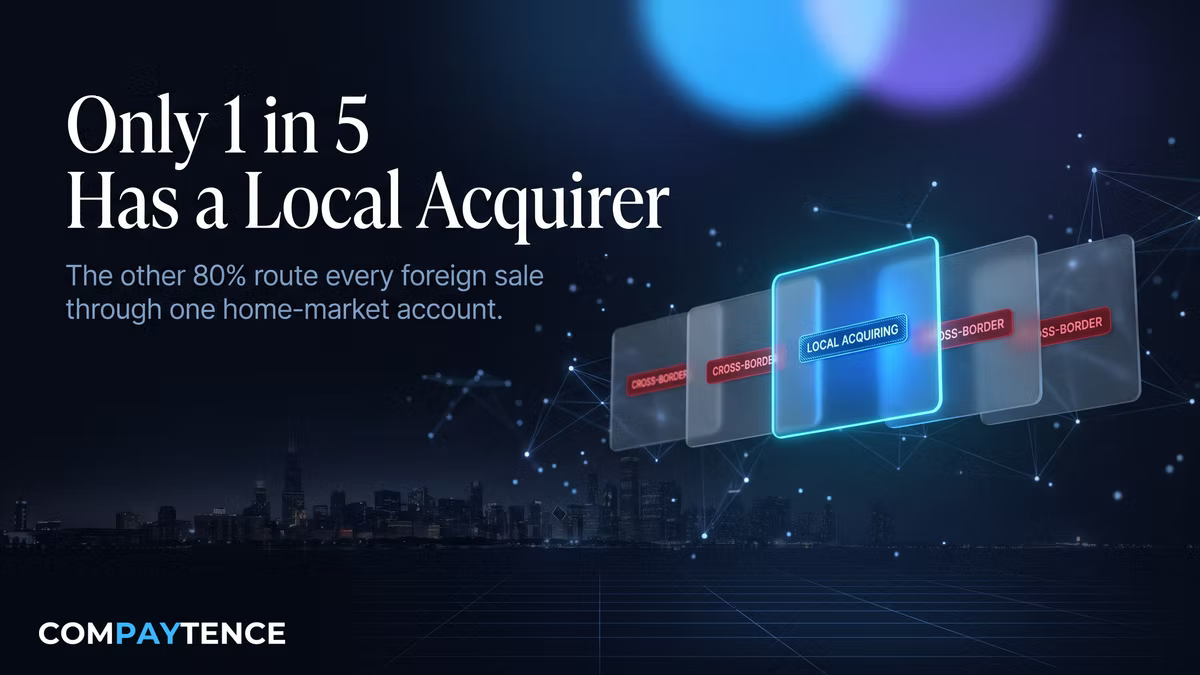
Only 20% of cross-border sellers have a local acquirer in their best foreign market. Everyone else routes those sales through a home-country account that prices, routes, and declines them as foreign risk.
Compaytence Brief · August 3, 2026
Only 20% of companies selling across borders have direct access to a local acquirer in their best-performing international market, according to Oxford Economics research. The other 80% run every cross-border sale through their own domestic MID, the merchant account tied to where their company is based. A German company selling heavily into the U.S. still processes every one of those sales through its German MID. American buyers end up treated as a cross-border risk on every transaction: higher decline rates, more checkout friction, and firm limits on which countries that account can even legally sell into.
Some of that comes down to regulation. A payment license issued in one country typically only works inside that country or the bloc it belongs to, through a mechanism called passporting. When the UK left the EU in 2021, London-based fintech Soldo lost the passporting rights that let its UK license cover EU customers, and had to stand up a second, fully licensed e-money entity in Ireland just to keep operating there. That's an extreme version of a problem every cross-border seller runs into at a smaller scale. A single account is licensed, priced, and routed for one region, and one region only.
The Hong Kong Workaround
Hong Kong's business registry hit 1.55 million companies in 2025, in a city of 7.5 million people. A meaningful share of those are formed by founders who've never set foot there, incorporated specifically for the banking access it unlocks rather than to sell into the local market. A Hong Kong entity qualifies for multi-currency business accounts through providers like Airwallex and Wise. These accounts issue local collection details, a US routing number, an EU IBAN, a UK sort code, so international customers pay the way they'd pay a domestic seller. Profits earned outside Hong Kong are largely untaxed under its territorial system, and the jurisdiction's banking reputation makes account approval easier than starting from a lower-trust one.
That's a genuine step up from a single home-country MID for collection and currency holding. However, it doesn't touch which acquiring bank processes the card transaction, the piece that actually decides authorization rates and checkout conversion.

Where Approval Rates Move
Local acquiring means the transaction runs through a bank operating in the cardholder's own country, so the issuing bank reads it as a domestic request instead of a foreign one. That detail is the single biggest lever over the approval rate itself. Local acquiring is capable of moving approval rates stuck in the mid-60s up to a healthy 85%.
Checkout conversion moves with it. Businesses offering local payment methods see roughly a 7.4% boost in conversion rate and a 12% increase in revenue, according to 2026 research from PPRO. That's on top of whatever declines are already happening on the processing side. Local acquiring is the piece that addresses both at once, directly inside the market where the sale is happening.
Renting Instead of Building
A merchant of record works differently again. An MoR becomes the legal seller in each market itself, taking on:
- Sales tax and VAT collection and remittance
- Chargeback and dispute liability
- Local compliance and PCI obligations
- Currency conversion on the transaction
The underlying brand keeps its product, its marketing, and its customer relationship throughout. Paddle, FastSpring, and similar providers can get a seller live in a new country in weeks instead of months, with no new entity, no new banking relationship, and no local acquiring agreement to negotiate.
That speed costs money. MoR providers typically charge 3% to 10% of transaction value. That's well above what the same sale would cost through an owned local acquiring setup once volume in that market justifies the investment. Most sellers using an MoR aren't choosing it permanently. It's the fastest way to test whether a market is worth the heavier lift of entity setup and local acquiring. The common pattern is starting there, then moving the highest-volume markets onto owned infrastructure once they've proven out.

The U.S. Is Usually the Market Worth Owning
For most sellers running this playbook, the U.S. is typically where that math tips first. It's often the single largest concentration of buyers outside a seller's home entity, which is exactly where an MoR's cut of each sale starts to add up.
The Compaytence U.S. Expansion Suite covers exactly this: U.S. entity formation, a fully remote FDIC-insured U.S. bank account, and payment processing routed through local acquiring with authorization rate analysis and chargeback protection built in. American buyers stop being priced and processed as a foreign afterthought on someone else's account. If U.S. sales already make up a meaningful share of your volume and you're still routing them through a single home-market account or an MoR, that's worth pricing out directly.
Sources: Checkout.com, research conducted with Oxford Economics, "What is local acquiring and what are the benefits for businesses?"; TechCrunch, reporting on Soldo's Ireland e-money license (2019); PPRO, research on local payment methods and conversion (2026); Paddle, "What is a merchant of record (MoR) and why use one for payments and sales tax?"